

Last month I shared a draft of my thinking and writing process about creativity and imagination. That post explains the origins of this framework, when I originally hadn’t intended to form a framework on creativity and imagination.
Process
That last post has been in mind since I drafted nearly two months ago. Letting thoughts lie fallow in the mind forms a part of thinking through a topic. Indeed, my framework situates imagination as sparks from the mind. Last month, I wrote:
Imagination. It’s that spark, but what sparks the recall of fragments that we have long forgotten? … It’s these sparks of recall and mentally constructing those fragments into possibilities that I’m calling imagination.
As a process for revisiting the last post, I had Sir Laurence Olivier read it to me. (You might hear the sound of screeching tires…wondering what I meant by that. Olivier is one of the ‘iconic voices’ in the ElevenReader app.) A significant change in how I process information is through hearing the spoken word through AI generated voices, even if it’s reading my own writing back to me. As I listen, I take notes on paper. I’ve resisted letting AI synthesize my last post and produce a neatly organized response. The temptation of having Claude, ChatGPT, or Gemini was really hard to resist at this stage. (I have things to do; I want to move on, get on with my life, publish this post, a tweet, or a YouTube video.) But, clarifying your own thoughts for yourself is foundational for understanding yourself. Later, I will have AI review what I’ve come up with through this process.
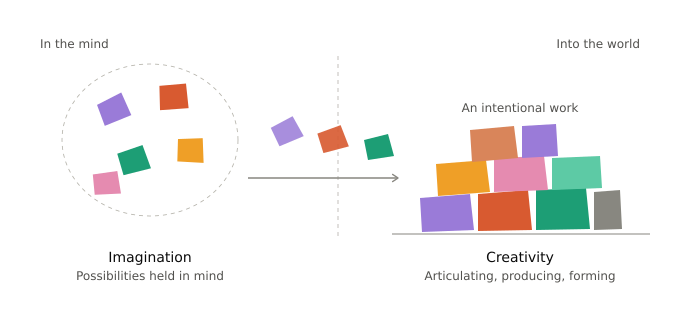
Creativity is the process of bringing those possibilities into the world.
The keywords, the building blocks for creativity and imagination, I have so far: fragments, experience, sparks, recall, mentally constructing, process, articulating (a more precise stand-in for ‘bringing’), possibilities.
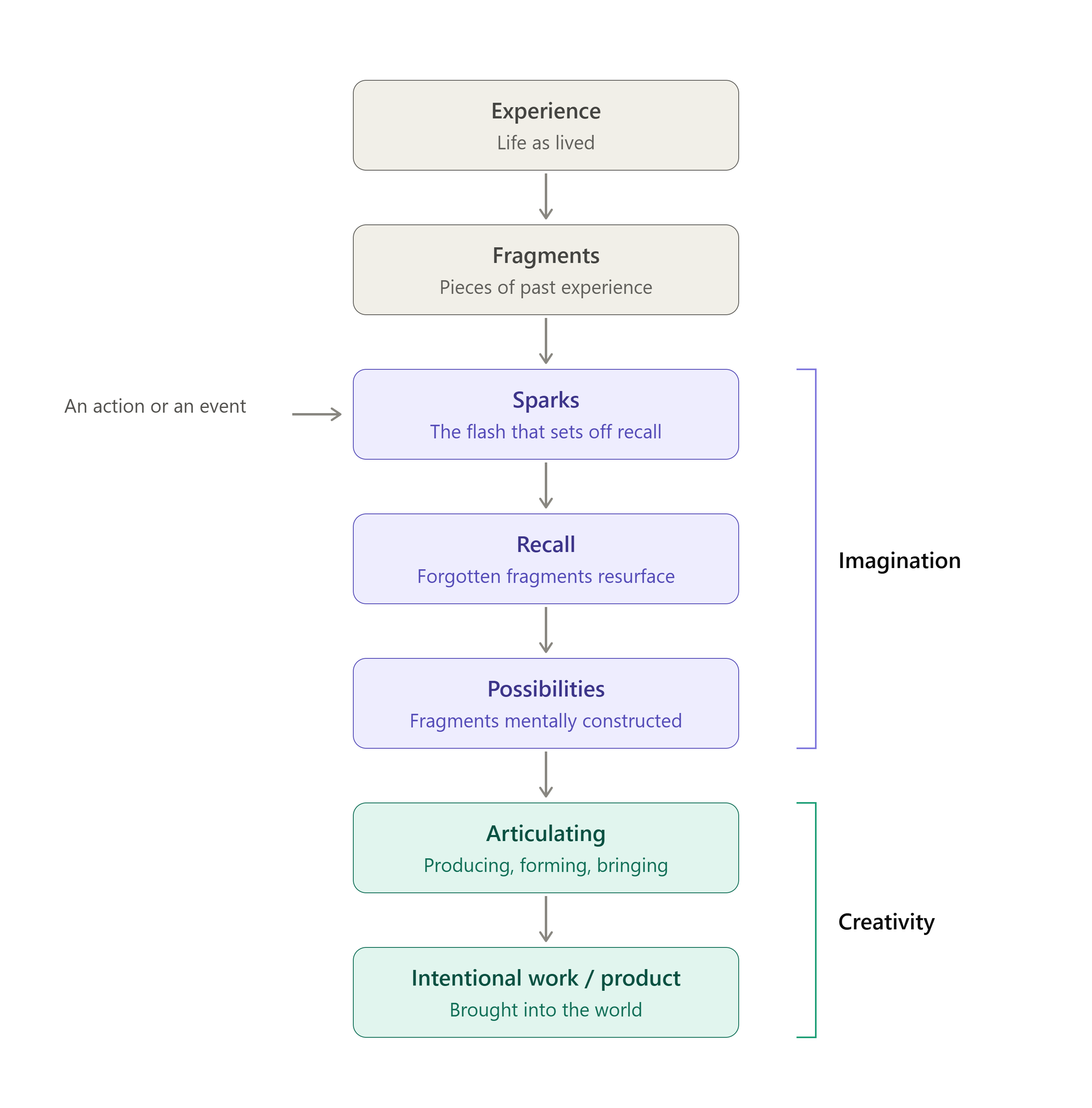
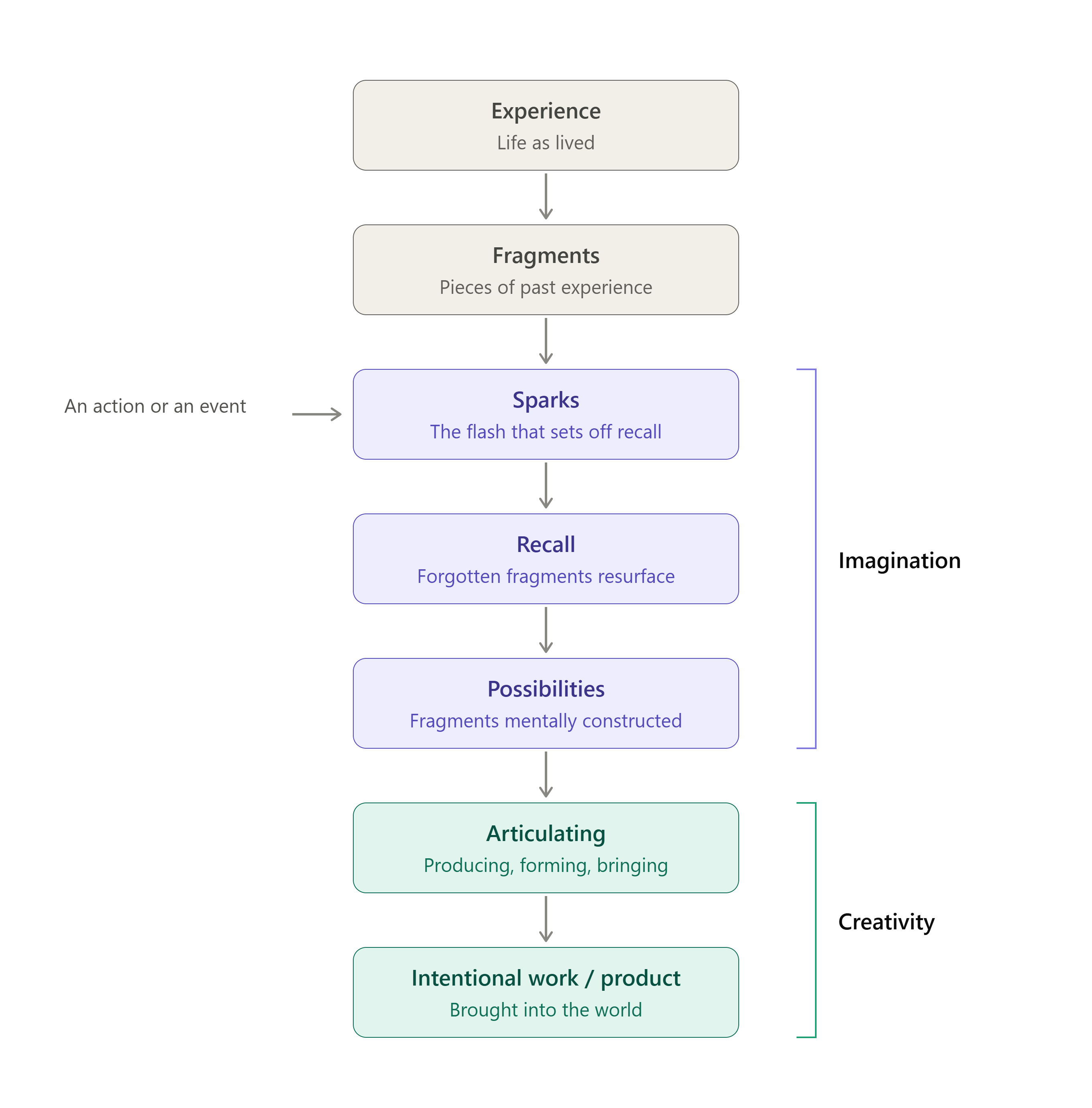
The jotted down notes of my reread spread over two messy sheets of paper resulted in a chain of experience → fragments → sparks → recall → articulating → an intentional work/product.
Obviously, in attempting to define imagination and creativity, you can’t use those words in the definition. Try writing a book about art without using the word art. It’s quite difficult.
At this point, I thought it would be helpful to have a diagram to clarify that chain of thought coming from my notes.
This is the prompt I gave Claude Fable 5, high effort. (That model is overkill for this task.)
At this point, I’m thinking through my own thoughts for how I think about creativity and imagination. I want you to create a diagram that visually explains the definitions I have formed so far:
Imagination. It’s that spark, but what sparks the recall of fragments that we have long forgotten? It’s these sparks of recall and mentally constructing those fragments into possibilities that I’m calling imagination.
Fragments of our life’s experiences.
Sparks of recall are triggered by an action/an event.
Creativity is the process of bringing those possibilities into the world.
Articulating, producing, forming are other words for ‘bringing’.
The chain i have at this point: Experience -> fragments->sparks->recall->articulating->an intentional work/product
I only want you to create a clarifying diagram based on what I have given to you. Do not yet provide any of your own insights about creativity and imagination.
The diagram Claude created:
Baseline
That diagram clearly outlines the thoughts I have so far about creativity and imagination. I’m titling this ‘Creativity and Imagination’ but why am I putting creativity first when imagination leads into creativity? Partly, purely for alphabetical reasons. Maybe I’ll switch it. I get the impression that people tend to think about creativity more than imagination, and it was my own thinking about creativity that led me to consider imagination.
Creativity is formed from fragments of our past experiences. Imagination is the sparks of recall that mentally construct these fragments into possibilities. Creativity is the process of bringing those possibilities into the world.
Structuring the 2nd draft
The process of writing a second draft of my essay is by finding a structure from the first draft. That structure is not necessarily in the order that the first draft was written since that first draft was free style association of thoughts. After I have a structure for the second draft (and it may take two or three attempts) to settle on a structure, I tend to proceed on writing the second draft. (Yes, this really could be a lot easier by just dumping my first draft into an AI. And I think there’s a lot of validity to that, depending upon what you’re trying to do with your writing.)
An obvious structure, which wasn’t obvious to me at all until a few moments before I typed this sentence, is that the diagram provides a structure. Let me try that: rereading the first draft, pasting paragraphs into an outline based on the diagram.
Even though I already know there are new concepts influencing my thoughts on this subject, I’m going to keep those out of this draft since I want to reflect separately on those concepts in relation to what I’ve already been thinking.
Here’s the 2nd draft, which I have labeled as v0.1 of the first public release.
Creativity & Imagination Framework, v0.1
This essay does not plant a flag that advances scholarship. Rather, this is a personal framework on where my thinking about creativity and imagination stands as of mid-2026.
We all have concepts floating around in our heads where we think we understand something, and we often vomit those thoughts into social media. Since examining the limits and capabilities of creativity in AI or with using AI to enhance our own creativity is my chosen work, I wanted to think this through more thoroughly.
Is my perspective valid? Or does it lead me astray, down a path I need not go?
As I read more about creativity and imagination, I’ll compare what I’m learning to my framework, and update the framework as needed, correcting misconceptions and adding sources that support my viewpoint. Over time, my framework might change completely. That’s how learning works.
Breaking down the framework.
Experience
The garden of our imagination is seeded by our experiences. For most of us, our imagination is like an overgrown lawn, an untended field of what some call weeds and others would see as a field of wildflowers.
No one has the same experience. The seeds are always different even if based on the same sources. The seeds of imagination are nourished, filtered by life experiences. The recall of each experience returns to us as fragments, harvested differently based on individual lived experiences. The time and manner of recall differs within a person. The same person may recall different fragments depending upon circumstances at that moment in time, and on what has stimulated the recall. Each of us has a different store of knowledge, even a person with the same education, a person who has taken exactly the same courses will bring his own life experiences that will impact his perspective, what he knows, and what he recalls. Even identical twins have different life experiences despite a childhood spent together.
Hence, the importance of taking notes, whether in a second brain tool like Obsidian, or on index cards, a commonplace journal, or recording an audio message to yourself. What you write down impacts how you will recall something later. Thoughts, by necessity, flee and, depending upon your memory, your mental capacity, you may never meet that thought again. (It’s usually the negative thoughts that we encounter again and again.)
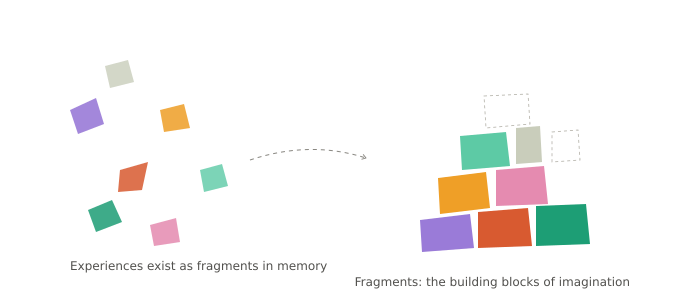
We all bring our unique experiences, our life experiences, our prior perspectives and knowledge, bits of all we have read, watched, or heard. Though we remember only fragments, we recall those fragments and piece them together.
What is this thing we call imagination?
Before we have imagination, we have our experiences.
Fragments
Our experiences exist as fragments in our memory. Fragments are the building blocks of imagination.
The pathway of imagination
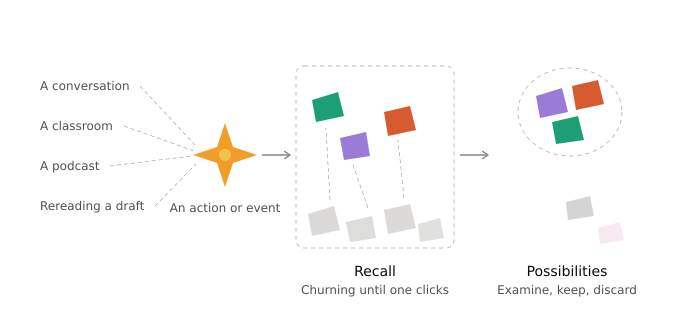
The pathway of imagination, per my framework, arises from an action or event (a spark) that sets off the recall, where the fragment surfaces and are mentally constructed into possibilities.
Action or event
Writing is a slow process. One sentence might trigger an idea, which is merely a thought that might have meaning. In writing a book, revisions stem from the author’s own rereading triggering changes. The role of first and second readers, and editors, are to prompt the author to consider sections of the book that do not work or needs adjustments.
Fragmentary recall is stimulated by any source. It may be a conversation, or classroom discussion, a hallway chat, or as wide ranging as a podcast.
Podcasts are stimulation machines.
Listening intently to a podcast is a way to stimulate your own thoughts. Podcasts have emerged as important sources that publicly present the process of a guide asking questions that stimulate the guest to, on-the-spot, articulate a thought in a concise manner. We all listen to different podcasts, and we all have different experiences that we bring in how we think about what we hear.
What does this framework say about education?
Teaching is not about instilling facts and whatever is defined as knowledge.
Education is the stimulation of the mind.
Education is the planting of seeds for our future use. Education is establishing a foundation in the student’s mind that later enables a person to make varied connections that will help him in life.
The inciting action is a spark.
Sparks
What sparks the recall of fragments that we have long forgotten (or misremembered)?
Creativity and imagination rests in the willingness to sit quietly, patiently, as you churn through mental fragments, hoping, attempting to come across the ones that click, the fragment you were, perhaps, unknowingly seeking.
Is that unknowingly seeking the core of imagination?
Recall
I’m better at writing than speaking because writing slows the process of surfacing what’s in my mind. Speaking spontaneously requires preparation, even if you know what you’re talking about. Recall for the purpose of public speaking is a process and a trainable skill.
An area that I want to read more about is the neuroscience of recall, how fragments exist within ourselves, and what determines which fragments stick around and which disappear forever.
Possibilities
The final step in the stage of imagination, before we get to creativity, is pulling those mental pictures from our mind, examining possibilities and making choices about which fragments we discard and which we ponder further.
Can AI imagine? People ask skeptically if AI can come up with anything new?
I say snidely, can most people come up with something new, an idea that has not been thought about before?
Based on this framework of imagination, AI can imagine. (Be careful when you use the word ‘imagine’, ‘imagination’. What are you really trying to say with that word? Or are you relying on some vague definition?)
What AI imagines will always be as different from the imagination of humans. Note that I don’t say that AI imagines any worse or better than humans. AI imagines differently, just as each individual person imagines differently based on experiences that form the fragments of memory and the actions that stimulate recall.
A remarkable use of AI is to prompt our imagination. Don’t take the output of AI as a whole cloth but use AI as a tool that sparks your own ideas.
Use AI to spark your imagination.
The Creative Process
Are imagination and creativity the same thing?
For me, creativity arises out of the imagination. Creativity is doing something with those fragments we have recalled. We all have great ideas. But articulating those ideas and bringing those possibilities into the world is the creative process.
My viewpoint on creativity and imagination is on the arts.
Art is the vaguest of words.
We think about art the wrong way. We view art as an object, a lovely piece in a museum, or an abstract painting that we’ve been told is art. Or we debate whether AI generated images are art.
Art is about the experience of creating and not the product of creativity. Many will disagree with that.
Artistry is intentionally piecing together fragments of our experiences in ways that will unexpectedly stimulate the audience to form their own thoughts, to establish a memorable part of their life experience, or merely designed to bring delight or horror (which is a variation of delight) to an audience. It’s all entertainment.
As an author (and I’ll use author broadly to avoid the overused term creator or saying ‘author, painter, sculptor, photographer, musician, dancer, singer, filmmaker, etc.’ repeatedly) you have no control over how others receive your creativity once you have let it loose upon the world. You have to let it go.
For the author, it’s the creative process that brings delight. For those who perform live (whether a singer in concert or a stage actor in a play), each performance is a creative act.
I dislike the label artist and distrust the intellectual honesty of anyone who labels himself too seriously as an artist.
Labels lack importance compared to process. Art is too often used as a value judgment bestowed upon the output of creativity.
An artist is one who is driven to intentionally enter an almost trance-like state of mind of sorting through the spontaneous recall of fragments and the need to express those mental images in some medium.
The process is shifting through mental images, activating more images from your brain, and the act of composition. That is creativity.
Creativity is among the greatest uses of one’s time.
AI will only replace human creativity if we let it. My aim with this (evolving) framework is as a tool for understanding the impact of AI on creativity. More importantly, how can AI be engineered to augment human creativity: storytelling, engineered with AI, directed by humans.