

On a morning earlier this month, I sat down to think about creativity and imagination. With my favorite pen (a Zebra F-701 ballpoint), I pulled out a legal pad and wrote by hand. After 3 hours of writing (and nearly 3,500 words later), I finished a first draft.
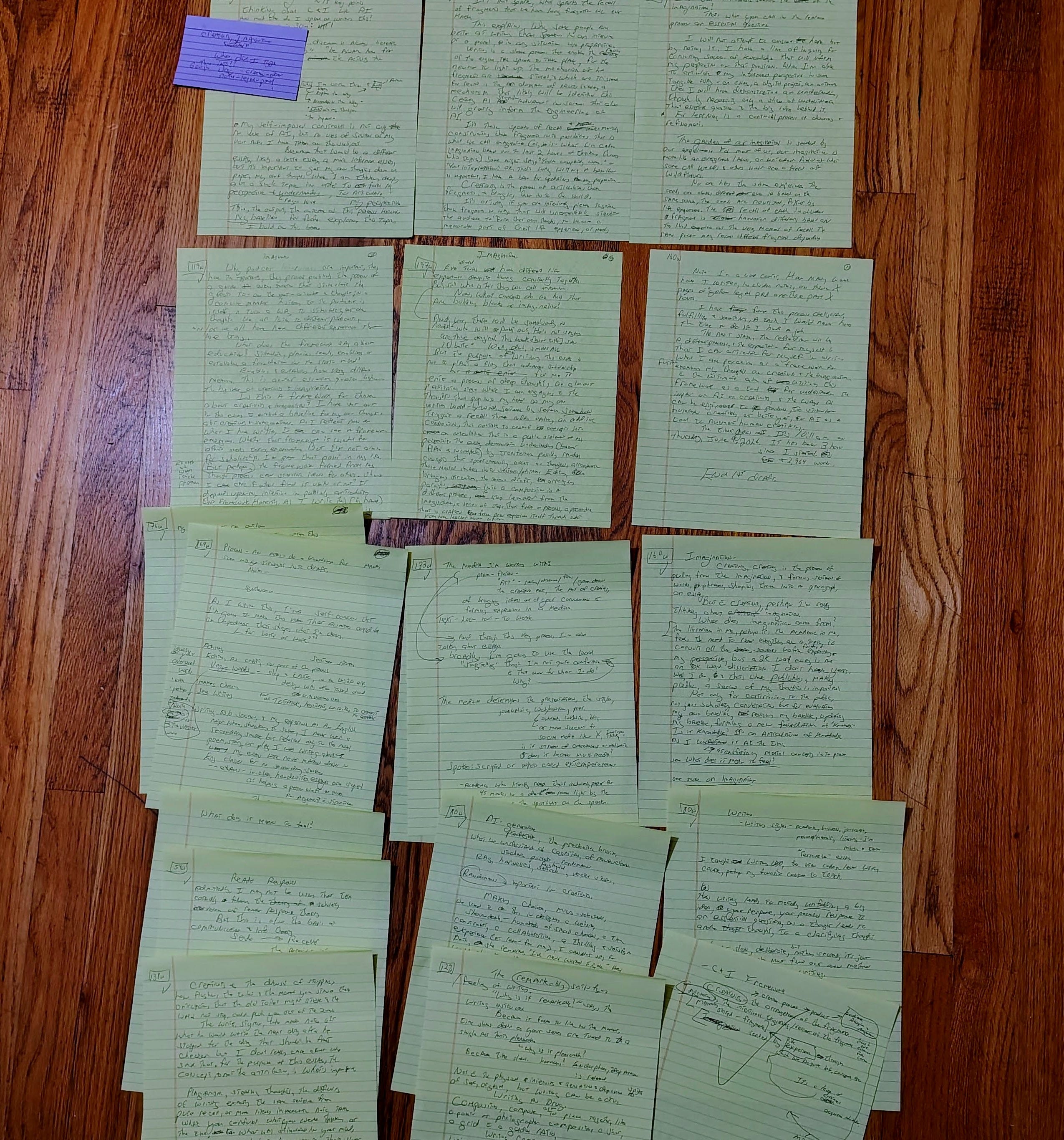
It started as a brain dump. Then the words flowed from the thoughts forming in my head. No external sources, no computer. I just wrote for 3 hours. That was one of the most satisfying experiences I had this year, as fulfilling as the long walks I took in France, England, Vietnam, and Japan this Spring.
Someone will scoff and say it’s easier to speak, record the audio and have AI transcribe it. Or, to to think through writing by typing into the computer rather by handwriting. You do you.
Abandoning the outline
Writing, thinking, creating in any medium is difficult to get started. I knew this would turn into an essay. I started with an outline. If I’m writing an essay that I plan to be around 1,500 words, I want to make an outline of 15 points that I want to cover. That’s one point for every 100 words. That’s a very rough guide, mainly serving to get the spark of ideas going. In this case, I only got 3 points down on paper (and a 4th that was the concluding paragraph) before I moved on. That’s okay. You can abandon the outline.
Jotting down notes
Looking around my home office, I see that I have 6 wooden boxes containing index cards. I don’t want to count the number of notebooks (more than a dozen), various papers and notes strewn over my work spaces. I’m embarrassed to show a photo of the 3 desks (and 6 bookcases) in my home office (which also doubles as my living room); the mess would likely induce anxiety for some people.
Note taking is an act I do throughout the day. I’ve tried tools like Obsidian but I can’t wrap my head around it. I do use GitHub extensively for notes about technical matters. I just realized that my paper notes are only for conceptual ideas, i.e., things I want to think further about. Anything tech-related to my coding projects, go straight into GitHub.
For this specific writing exercise, after I abandoned the outline, I started writing notes on different pages of the legal pad. Of the 3,500 words I wrote that morning, around 1,200 were notes that I needed to capture, that I wanted to include, but needed noting before disappearing from my mind. My intention was that I would pull these notes together to finish the outline. That never happened, instead the ideas started to flow into the first draft. The outline was only a key to unlock the writing.
I mostly also abandoned the notes, and wrote without referring back to what I had noted earlier except when I wanted to find a phrase that had previously come to me.
Inspiration?
Where do the thoughts come from? That’s the core of creativity of imagination. That’s what I thought through in this writing exercise.
Use no sources
As a former university professor, as a former librarian, I know not using sources is sloppy research. But the goal of this writing process was not to produce published research. I wanted to set a baseline of my own thoughts on the topic. Obviously, though, these thoughts have been informed by everything I’ve read over the years. And, certainly, I did not use AI at all in writing that draft or in this post.
Challenge yourself to set out your thoughts in writing without referring to external sources. (You don’t have to do it by hand; do what works for you.)
Plagiarism? For this purpose, setting a baseline of your viewpoint, don’t worry about plagiarism, yet.
Finding your own framework
The aim is not that these thoughts are fully formed but that I, personally, now have a better understanding of my mental framework for thinking about creativity and imagination. The emerging framework will inform how I examine the limitations and capabilities of AI in creativity and imagination. The next step for me is to revise this draft into a coherent framework that I can use when reading what others are writing about on creativity and imagination. Most importantly, having this baseline of my own framework allows me to update my thinking as I consult the research and listen to others.
As I set out to write this draft, I was not seeking to establish a framework. You’ll see in the draft how it emerged as I was thinking.
We rarely get to see the first draft of another. I doubt many of you can read my scribbling on those yellow pages. Sometimes I can’t read my own writing. I did type up my notes and draft. Below, I’m including the draft, slightly edited for most spelling errors, though I kept the lack of capitalization from when I transcribed the essay. I didn’t correct this draft for grammatical errors. This rough draft wasn’t intended for others. I’m including it here as an example of the process. This draft was written in one sitting as a stream of consciousness.
The first draft
My self-imposed constraint is not only no use of AI, but no uses of sources or my vast notes that i have taken on this subject.
because that would be a different essay, likely a better essay, a more informed essay, but it’s important to get my own thoughts down on paper, my own thoughts where i am thinking deeply about a single topic in order to form my perspective and understanding, to articulate my perspective.
This, the output, the outcomes of this process becomes my baseline for further exploring this topic. I build on this base.
my thoughts may change but i always must be aware of how my thinking is shaped by another, is it correct, does it have validity?
do i feel it leads me astray, down a path i need not go, or do i feel it’s wrong, and then i must be able to articulate a different interpretation, a different perspective that is equally as valid as my own, writing an essay, an article a book, giving a presentation, making a video, or being on a podcast captures your perspective at that time. it solidifies thought into what is hopefully a clear expression of ideas, though on a podcast, it’s often thinking out loud, as often is the case in meetings at work.
but, wait, isn’t this essay about creativity and imagination? let’s get back to imagination.
sidethought: some say they they speak faster than they write. Not me. yet, i type faster than i write by hand. turning the page at this moment could take me out of the flow. i’m a word counter.
Imagination.
It’s that spark, what sparks the recall of fragments that we have long forgotten? fragment that we might have realized we ever know. Events we have misremembered.
this explains why some people are better at writing than speaking in an interview or a panel, in any situation without preparation.
writing is a slow process that enables the revving of the engine, the spark to take place, for the neurons to light up. the mechanism of how fragments are stored, and which are triggered for recall is the domain of neuroscience, a mechanism that likely will be identified this century as significant advancements in science that also will greatly inform the engineering of ai.
It’s these sparks of recall and mentally constructing those fragments into possibilities that is what we can imagination (or, it’s what i’m calling imagination based on the last 2 hours of thinking through this topic.)
side thought: it’s easier to respond, to critique, an essay/article, than it is to create it.
Some might say, ‘you're completely wrong.” or “”your interpretation” ok, that’s why writing as a baseline is important, i have a base for updating my perspective.
Creativity is the process of articulating those fragments and bringing them into the world.
it’s artistry if you’re are intentionally pieceing together these fragments in ways that will unexpectedly stimulate the audience to form their own thoughts, to become a memorable part of their life experience, or merely designed/composed to bring delight or horror (which is a variation of delight) to the audience. That’s entertainment. See Graham Greene’s description of some of his novels as entertainment.
and as an author, painter, filmmaker, etc. you have no control over their experience of your creativity once you have let it loose upon the world. you have to let it go.
as an audience also, you must be careful of other’s interpretations before you form your own, or even later, and not let another’s interpretation ruin your enjoyment of a piece, a song, a film.
that’s why i propose that creativity and imagination about about the experience of the creator, the creative process brings delight to the author (and i’ll use author broadly to avoid overusing the term creator or saying, author, painter, sculptor, photographer, etc repeatedly)
part of that creative process is style, adding a stylistic arrangement to the composition, this is where originality lies, but depending upon the medium and the intent, originality, the arrangement is only important to the author if she chooses it to be so. it’s the process of shifting through mental images, activating more images from your brain, and the act of composition that is creativity and of the utmost importance to the author. creativity is the greatest use of own’s time, no, that’s not a good way of expressing what i’m thinking, struggling to bring a jumble of thoughts in my head before they escape back into that mysterious darkness.
creativity and imagination rests in the willingness to sit quietly, patiently, as you churn through mental fragments, hoping, attempting to come across the ones that clicks, the fragment you were, perhaps unknowingly seeking.
Imagination. Is that unknowingly seeking the core of the imagination?
That’s what you call in the learning process an essential question.
i will not attempt to answer it here but by noting it, i have a line of inquiry for consulting sources of knowledge that will inform my perspective on that question. when i’m able to articulate my informed perspective in some tangible way, an essay, a digital project, an artwork, then i will have demonstrated an understanding though by necessity only a slide of understanding that essential question and the big roles behind it.
for learning is a continual process of discovery and refinement.
the garden of our imagination is seeded by our experiences. for most of us, our imagination is more like an overgrown lawn, an untended field of what some call weeds and others would see as a field of wildflowers.
no one has the same experience. the seeds are always different even if based on the same sources, the seeds are nourished, filtered by life experiences. the recall of each in divided fragments is harvested differently base on the lived experience at the very manner of recall. the same person may recall different fragments depending upon circumstances at that moment in time, and what has stimulated the recall. hence, the importance of taking notes, index cards, a commonplace journal, or recording an audio message to yourself. what you write down, the recall you are capturing are thoughts and by necessity they will flee and depending upon your memory, your mental capacity, you may never meet that thought again (it’s usually the negative thoughts that we meet time and time again.)
you see, here is how it works:
what i just wrote triggered an idea, which is merely a thought and that might have meaning. the idea, the artistry, the desire to create, is driven by the spontaneous recall of a recurring thought or set of thoughts, the continuous recalling of a series of thoughts that move us towards the act of creation, the need to express those mental images in some medium, whichever is the form of your choice.
or, the recurring thought, the call to action, is simply an ongoing feeling, a need, to make the time to sit down and enter that almost trance-like state of mind where you are being creative.
why podcast interviews are important, they have the opportunity, they present publicly the process of a guide asking questions that stimulate the guests to an on the spot articulate a thought in a concise manner. listening to the podcast itself, in term is a way to stimulate your own thoughts. we all listen to different podcasts, and/or we all have had different experiences that we bring.
what does this framework say about education? stimulation, planting seeds, enabling or establishing a foundation in the student’s mind?
enabling and establishing have very different meanings. this is another essential question behind the big idea of creativity and imagination.
is this a framework for thinking about creativity and imagination? i have set out in this essay to establish a baseline for my own thoughts about creativity and imagination. as i reflect now on what i have written, i can see a framework emerging. whether that framework is useful for others needs testing, examining. but i’m not aiming for scholarship. i[’m past that point in my life. but perhaps (which is an example of a tentative phrase that i shouldn’t use, that i will edit out) the framework formed from my thought process, can stimulate ideas for others. should i care if others find it useful or not? it depends upon my intentions in publicly articulating this framework. honestly, as i write this by hand, i don’t care. my concern at this point is refining my own thoughts on creativity and imagination. this framework has become my baseline, version 0.1., as of June 2026.
i’m stopping now, or rather i will stop in 12 minutes, when my Pomodoro timer goes off.
the next stage of writing as thinking is to refelct on what i have done so far. reread and review my notes, and bring structure to my output. what started 3 hours ago as a bare outline and the jotting down of word and phrases morphed into a free flow state of writing, a first draft. i should publish as much of this draft as possible, just as i wrote it so that other s can see this stage of the writing process, a stage that is usually discarded or hidden in the writer’s archives, possibly someday, if the author is notable, to be stored in the controlled climate of a library’s special collections vault where it will wait unseen for years, possibly decades, possibly forever unless a researcher tracing my intellectual evolution uncovers the draft, the odds of that every happening is is low. i will be forgotten. thus, here is the first draft of my thoughts on creativity and imagination based on 60 years that have formed the experiences of my life.
even identical twins have different life experiences despite being constantly together. but, still what is this thing we call imagination.
now, what concepts do we have that are building blocks of imagination?
And, yes, there will be somebody on reddit who will point out, “He’s not saying anything original . this book [insert title] says it better.” well, duh, smart ass.
but the purpose of me writing this is essay is not t o plant a flag that advances scholarship but for me to enter a process of deep thought, an almost meditative stage where i am engaging with the thoughts that pop into my head as my own writing word by word, sentence by sentence somehow triggers a recall that adds value, an additive connection, that continues to connect concepts into an articulation that is a public statement of my perspective. this essay demonstrates understanding (however flaw and incomplete) by transferring possibly random concepts that spontaneously occur as thoughts, arranging these mental images into sentences/phrases; editing, bringing structure, the second draft, arranging paragraphs into a composition is a different process, a step removed from the imagination, a series of steps that form a process, a procedure that is crafted from prior experience itself through what you have learned about writing.
what’s the latin root of imagination. what other words in other cultures convey this concept.
how words impact our thoughts. all mental. this is the mystery.
pulling mental pictures from our mind, making choices, selections, and piecing them together.
of course, ai can imagine? people ask sceptically but can it come up with anything new?
i say snidely, can most people come up with something new, an idea that has not been thought about before?
but people can come with a new way of expressing an idea.
we all bring our unique experiences, our life experiences, our prior perspectives, and knowledge, bits of all we have read or watched, though we remember only fragments, we recall those fragments and piece them together.
fragmentary recall may be stimulated by a conversation (the role of first and second readers and editors) the importance also of being encouraged in your writing so that you don’t wither under criticism.
stimulated by other sources. podcasts are great mental stimulators. podcasts as stimulation machines.
each of us has a different store of knowledge, even a person with the same education, who took the exact same courses will bring is own life experiences that will impact his perspective, what he knows, and what he recalls.
We sometimes use that as a shorthand for saying how smart someone is or how intelligent a person is, but smart and intelligent are not really meaningful are they? Other than as measures of life experiences?
Note: i’m a word counter. how many words have i written, including notes on these pages of a yellow legal page over the past 3 hours.
i have found this process delightful, fulfilling and something, a task i would never have the time to do if i had a job.
the next stage, the refection will be a different process, and the expectation for myself is that i can articularte for my self in writing what i am perceiving as a framework for further examining my thoughts on creativity and imagination. important to note that i didn’t start out intending to think in terms of establishing a framework.
a framework with the ultimate aim of utilizing this framework as a tool for understanding the impact of ai on creativity and the ways ai can be engineered to produce, to stimulate human creativity, or better yet, for ai as a tool to augment human creativity.
the timer goes off. it’s 10:11am on thursday, june 4, 2026. it has been 3 hours since i started