

I have no interest in reading stories written by AI. Or, at least until tonight, I thought.
When AI writing ceases to be slop
At the end of this post is a story written by Claude Opus 5.5 on September 22, 2026. My reaction is unexpected. I have rolled my eyes at all previous attempts by Claude or ChatGPT at fiction. Sometimes the plots would be intriguing but the prose would be so cliché and overwritten. For me, this story—The Sitter—is not AI slop. If by AI slop, you mean writing that lacks creativity and not a pleasing experience. If by AI slop, you mean anything generated by AI, then that’s a different topic of discussion.
I know quality fiction when I read it. More than 50 years of reading has provided some insights. Currently, I’m making my way through the collected works of Yukio Mishima. My two favorite novels are The Magic Mountain and Absalom, Absalom. And I have a degree in English. I only say all that as an indication that I am “well-read”, as people say, in literary fiction.
Certainly, there are flaws in this story. Likewise, almost every published story has flaws when you are seeking those out. (It always has been easier to criticize than to create.) There are aspects of this story, particularly some line editing, that I would change but not all that much. I’m reprinting the story exactly as it was generated by Opus 5.5.
If a work brings joy and pleasure of some type to a person, does it matter if it was created by AI?
The reading experience is personal
Without getting into the deep waters of reader-response theory, my reaction is surely influenced by the seed for this story and how the story generated by Opus 5.5 speaks to me, almost as if written for me.
Written for me: it was written for me, and we may be in an era where a genre of fiction utilizes aspects of what the AI knows about the individual reader.
Now, don’t get all flustered that this is going to replace all novels and stories. I said a genre of fiction. New genres are emerging with AI-enabled media.
The seed for this story
One Spring day in March 2008, I was walking through the neighborhood of San Telmo in Buenos Aires. Our apartment was on the edge of that barrio. I came across this photo on the ground.
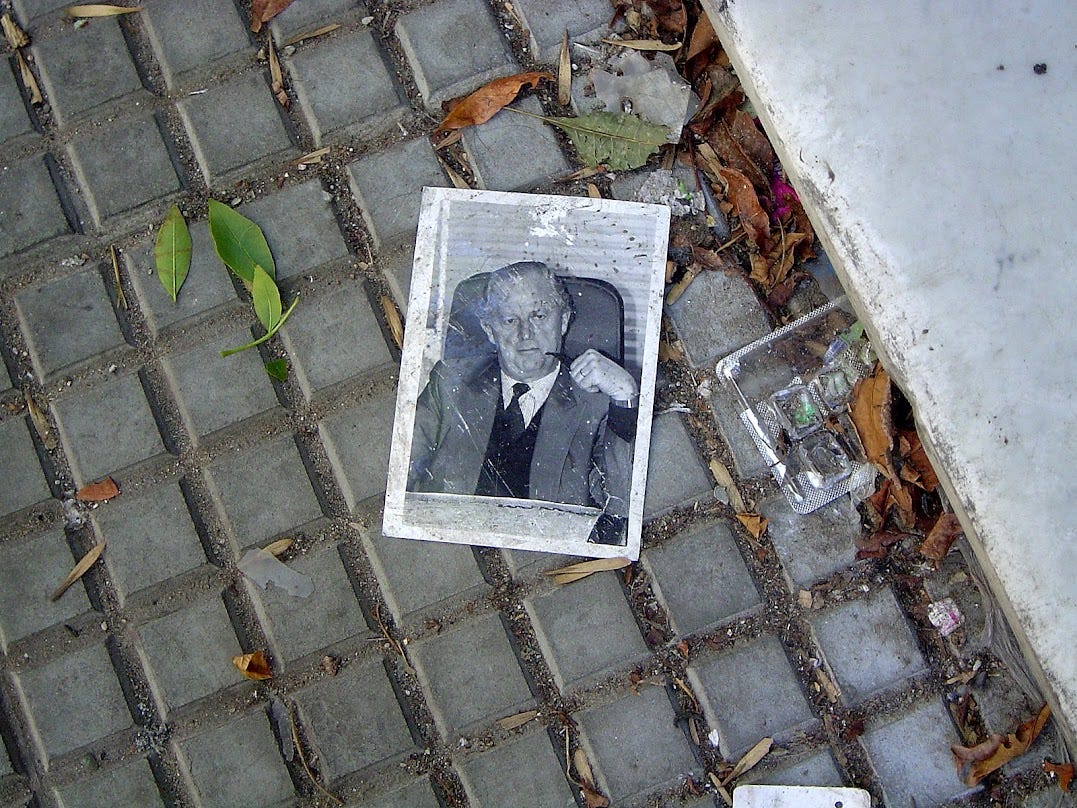
Unusual, I thought. In all my years of walking the streets of Buenos Aires, I don’t recall coming across a stray photograph. I snapped a photo with the camera I had with me at the time. (This was before smartphones.) I picked up the photo, and took it home. I’ve lost the photo in one of many moves from apartment to apartment in those years. But this little discovery has stayed in my mind. At the time, I also wrote briefly about it on the blog that I kept about my occasional walks in Buenos Aires, 2005 - 2013.
Opus 5.5 has just been released, and I’ve come across postings on X about how the writing style of Opus 5.5 is better. I wanted to test that. My expectations were low.
The prompt. I gave Opus 5.5 this image and the prompt:
In 2008, I found this photo on the ground in barrio del San Telmo in Buenos Aires. I do not know anything about the man or the photo. Imagine a story, in the style of Borges, about the man coming to life from the photo on the ground.
The “in the style of Borges” will definitely steer Opus in a particular direction. Borges’ style of writing is difficult, and most creative writing professors would advise, “Don’t try to write like Borges.” Generally, I do not like using in the style of [insert artist] in prompts. But this was just meant for evaluation, a quick benchmark, that I never expected to share because I thought it would be incredibly bad.
The story’s premise is derivative. Yet, my response to the story took me by surprise. I had to reread it a couple of times. Then I uploaded it to ElevenReader and had the voice of Laurence Olivier read it to me. I listened, then I listened to the story again.
Coincidence or context?
Others may not feel the same way about this story, and that’s okay. The personal connection I have to that photograph and the way that the story weaves details of Buenos Aires resonate with me: the named streets of San Telmo, the fair in Plaza Dorrego every Sunday. The description of Parque Lezama, where I used to walk everyday, and the benches where I sat near the massive ombú tree.
Buenos Aires at night holds a second population, the photographed, who walk the same streets as the rest of us and order nothing in the cafés and stand at the edges of plazas looking at the fronts of buildings as though at faces they almost recognize. I have seen them since. Anyone can, at four in the morning, at the Británico across from Parque Lezama
Among my best memories of Buenos Aires are from those streets, particularly the street corner where Bar Británico has been located for nearly 100 years. It was my “office” where I sat for hours writing, reading, and simply observing. In my years of living in Buenos Aires, Bar Británico was opened 24 hours and I recall sitting in the Británico with friends all night until the sun rose over Parque Lezama.
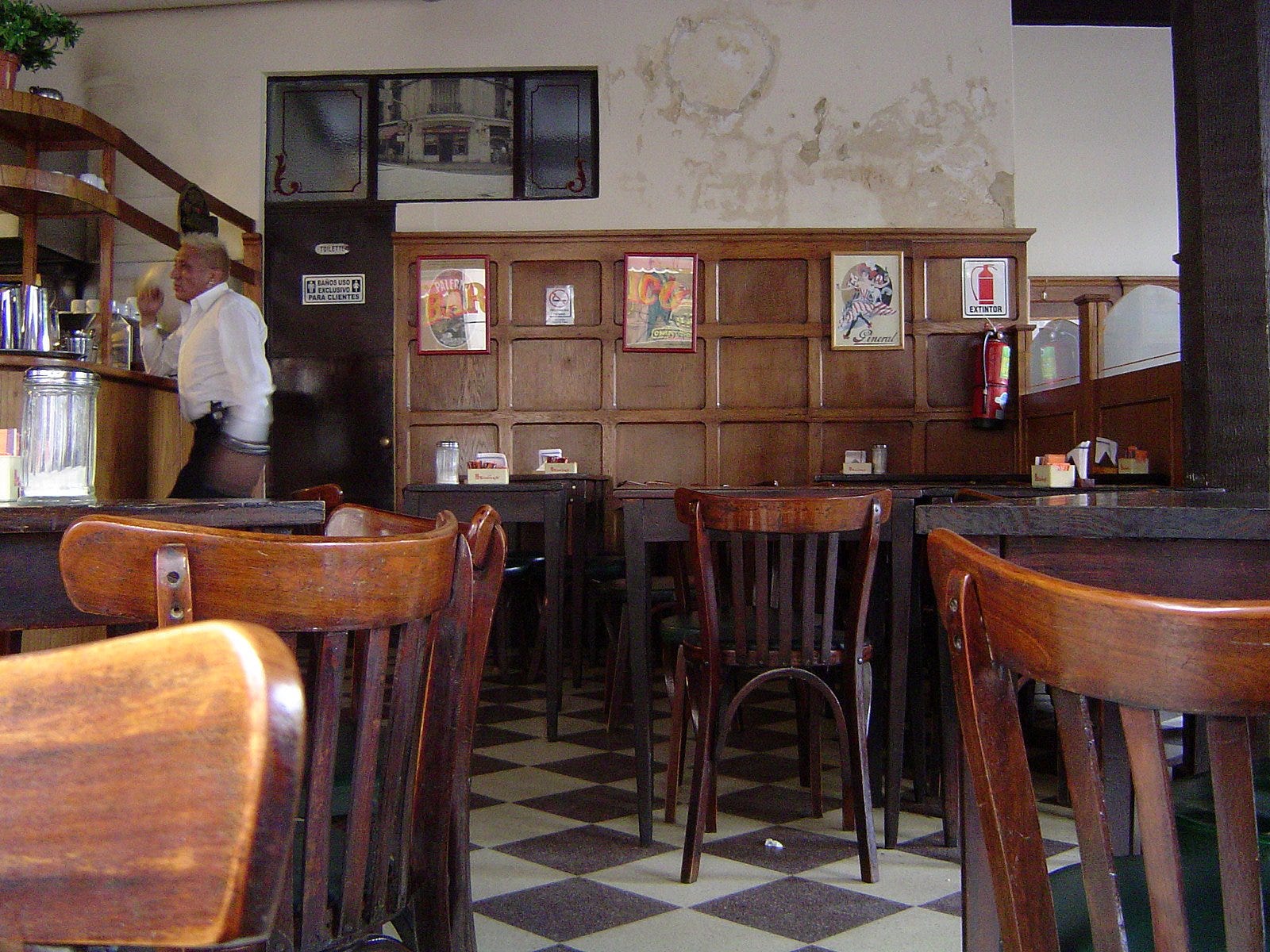
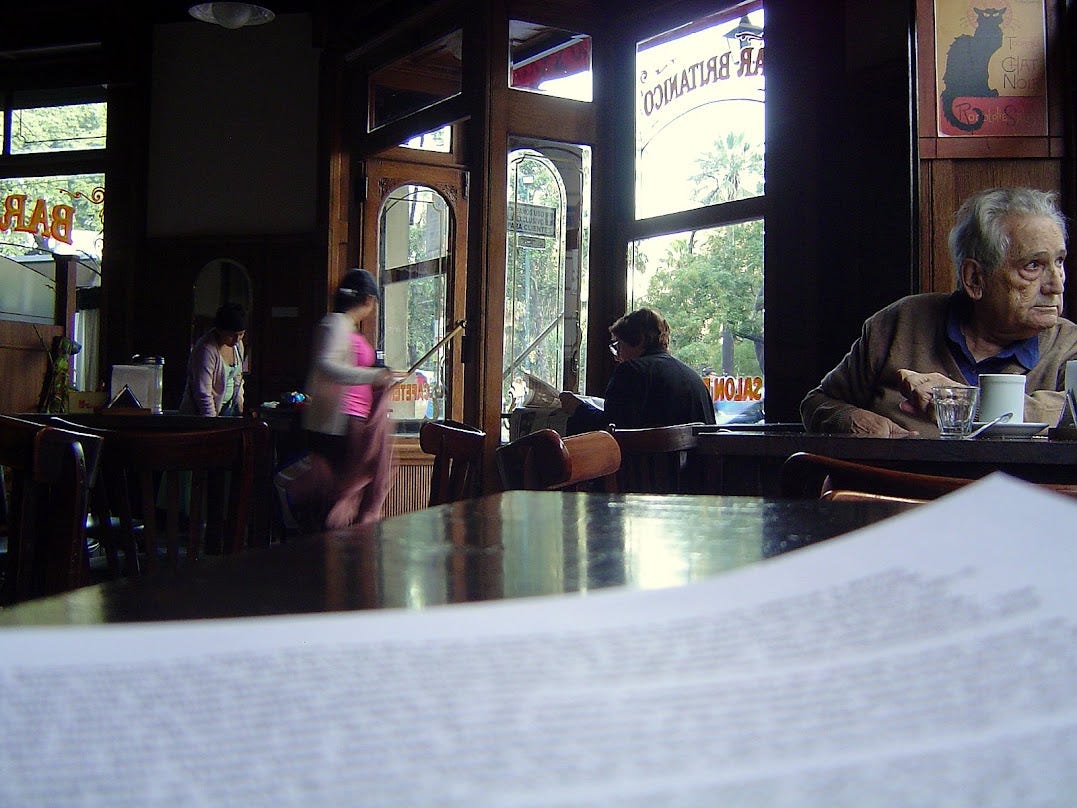
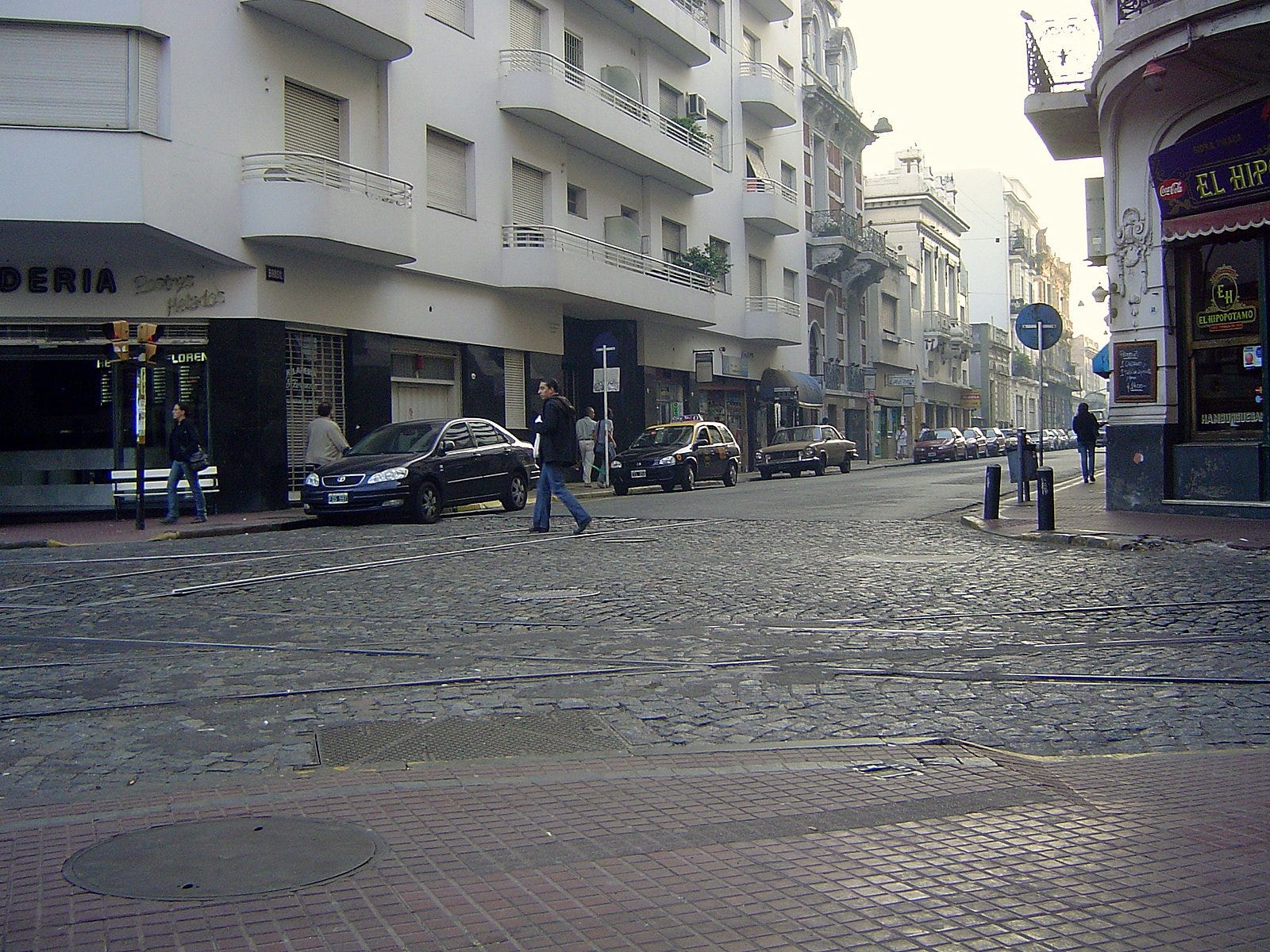
On the opposite corner is El Hipopótamo, another classic of Buenos Aires. My most vivid memories are not in photographs, like the time when Francis Ford Coppola and Vincent Gallo sat at the table next to me in the Británico where Coppola talked (loudly) about directing Brando and Gary Oldman. The entire bar was listening in on that conversation.
A good story makes connections and stirs a response within the reader. Maybe the story below doesn’t evoke any emotion for everyone.
Claude knows a lot about me. It knows about my experiences in Buenos Aires. I used Claude Code to migrate my old WordPress blog (Buenos Aires, City of Faded Elegance) to a static site. Claude knows about my other writings on Buenos Aires, and my blog surely was scraped from the Web and sucked into the vast training data.
An easy experiment: upload the photo and prompt into a Claude account with no context of myself. What variation of a story does the system produce?
If no one else finds this story to be more than AI slop, then that’s more remarkable: personalized storytelling unique and only meaningful to the person requesting the story. That's a genre only possible through AI.
The Sitter
Every photograph is a mirror that has forgotten whom it reflected. — Heráclito Ruiz de Lomas, Tratado de las sombras fijas (Montevideo, 1889)
I found him on a Tuesday in March of 2008, a little before noon, on the paving stones of Humberto Primo, a few steps from its corner with Defensa. He lay face up among the fallen leaves of a paraíso tree, beside the marble step of a house that had once been important and an empty blister of pills whose purpose I preferred not to guess. The pavement of San Telmo is made of small square stones, each one slightly swollen, so that the city there resembles an enormous quilt, or the board of a game whose rules have been lost; the photograph lay across nine of these squares, and I remember thinking, absurdly, that it had been placed rather than dropped.
It showed a man of perhaps sixty, seated in a high-backed leather chair. He wore a three-piece suit, a white shirt, a dark tie. He held a pipe to his mouth with the gesture of someone who has been asked to hold still and has decided, out of courtesy, to obey. His expression was that of a man who has just been quoted a price and finds it reasonable. Rain, or years, had worn a pale constellation into the upper corner; a crease crossed his chest like a ceremonial sash. I did not turn the photograph over. I cannot say why. Perhaps it was the same instinct that makes us leave certain letters unopened, not from fear of what they say but from reverence for the moment before we know.
I must here record a digression, since without it what follows would be merely incredible, whereas with it it is only improbable.
In the old National Library on Calle México, a few blocks from where I found the photograph, there was once a copy (the only one, I believe) of the Tratado de las sombras fijas of Heráclito Ruiz de Lomas. Its thesis is simple and, like all simple theses, inexhaustible. The camera, Ruiz de Lomas argues, does not capture light; it captures duration. The two or three seconds during which the shutter stood open are not a picture of time but a portion of it, sealed like water in a jar. A sealed instant is inert, but it is not dead. It waits.
What wakes it, according to the Tratado, is the gaze, but not every gaze. A widow who looks at her husband’s portrait sees her husband, which is to say she sees her own memory; the photograph does no work and receives nothing. Only the gaze of a stranger, who knows neither the name nor the date nor the outcome of the life, feeds the sealed instant with time that is not already its own. Ruiz de Lomas calculated, with the arithmetic serenity of his century, that a photograph left face up on a public street for a single day receives more ignorant glances than a family album receives in a hundred years. He further calculated the number required for the sealed instant to rise, stand, and walk. I will not reproduce the figure; it is either too high or too low, and I have come to suspect it depends on the pavement.
Ruiz de Lomas died in 1902, some say in the asylum at Open Door, others that he never existed at all. I incline to both opinions.
I carried the photograph to my room on Calle Chile and propped it against the base of the lamp. I did not look at it again that day, or I looked at it in the way one looks at furniture.
That night he was sitting in my only armchair. I say *sitting*, but the verb is imprecise: he held himself as though his back rested against a height that was not there, the tall leather of the studio chair, which he had not brought with him but whose shape he could not stop occupying. The pipe was in his hand, unlit. He was entirely gray. I do not mean pale; I mean that he was composed of the same limited palette as the print, so that the yellow light of my lamp seemed to fall on him and fail.
“No se mueva,” he said, and then, seeing my face, apologized. It was, he explained, the last thing he had heard, and it had worn a groove in him.
He remembered that one instant with a perfection I have never known about anything. The photographer’s voice from behind the black cloth. The sweet chemical smell of the studio. A fly walking up the windowpane toward a light it would never reach. The discomfort of a collar stud. Everything else (whether he had a wife, what he did for a living, what city lay beyond the studio’s door, though he supposed it was this one) he had to deduce, the way astronomers deduce an unseen planet from the tremor of a star.
“I am not him,” he told me, with the gentleness of a man correcting a waiter. “He stood up. He paid. He went down the stairs and lived another fifteen or twenty years and died of something ordinary. I stayed. I am the four seconds he gave away.”
He asked me to help him find his name.
I recall the weeks that followed in a disorder I have chosen not to correct. We walked at night, when the streets of San Telmo are emptiest and the cobblestones give back the day’s heat. We stood outside houses on Balcarce and Carlos Calvo that he thought he might have entered once; he could never be sure, because the only interior he truly knew was a photographer’s studio, and all studios, he said, are the same studio.
One Sunday I took him to the fair in Plaza Dorrego. I had seen, among the siphon bottles and the tango sheet music and the brass doorknockers shaped like hands, a dealer who sold shoeboxes of photographs under a hand-lettered sign: fotos de desconocidos, un peso. My companion bent over the box, and I watched him grow, if such a thing is possible, grayer.
In that box were a bride of 1923 who had outlived her groom by half a century; a boy in a sailor suit, frowning at something outside the frame; three soldiers of a war Argentina did not fight; a dog; a woman laughing so hard that her face had blurred; a family arranged on a staircase like the notes of a chord; a man in a hat who resembled my companion so closely that for a moment I thought the box contained a mirror. None of them had names. All of them, I understood, had been looked at by strangers.
He understood it before I did. He was not a prodigy; he was a citizen. Buenos Aires at night holds a second population, the photographed, who walk the same streets as the rest of us and order nothing in the cafés and stand at the edges of plazas looking at the fronts of buildings as though at faces they almost recognize. I have seen them since. Anyone can, at four in the morning, at the Británico across from Parque Lezama, if he knows nothing about them and does not try to.
It was on a bench in Parque Lezama, under the great ombú, that he told me the rest.
“You must not look for it,” he said.
“Your name?”
“The gaze that knows gives nothing. If you learn my name, you will look at me and see a fact, and I will fold back into the paper the way a letter folds back into its envelope.”
I asked him why, then, he had asked me to help him search.
He considered the question for a long time, turning the cold pipe in his fingers. “The faithful search for God,” he said at last, “and most of them would be terrified to find Him. It is the searching that keeps them alive. Why should I be different?”
I confess I was tempted. I have spent my life putting things in order, assigning each object its number and its shelf, and I had noticed, along the bottom border of the print, the ghost of a studio’s stamp: a few letters, the first digits of an address on Calle Florida. A week in the right archive would have been enough. I did not go. I understood that the kindest thing I could do for him was the one thing that went against my nature: to leave him uncatalogued.
He stopped appearing in the winter of that year. It was not because I learned anything. It was because I had come to know him, and I had forgotten that familiarity, too, is a kind of knowledge. Each night he was a little less gray and a little more paper, and one night there was only the chair.
On our last evening he asked me a question I have not been able to set down since.
“And you,” he said. “Who photographed you?”
I told him about a photograph taken when I was a boy, on a porch in another country, in a light I can no longer describe. It was lost when my parents’ house was sold. I have no idea where it went.
He nodded, as a man nods who has been quoted a price and finds it reasonable.
I have kept the photograph. I have never turned it over. Sometimes, crossing a plaza, I feel on my face the weight of a gaze that knows nothing about me, and I understand, with a mixture of terror and gratitude, that somewhere, on some pavement I will never see, among leaves whose names I do not know, a stranger has stooped to pick me up and is wondering who I was; and that it is only by the grace of his ignorance that I am able to write these lines.