

Last week, I drove nearly 1,200 miles over three days for a family reunion. I have 25 first cousins on my father’s side of the family. Some have passed away; some will not be able to make it to the reunion. On the way, I listened to an audiobook of The Odyssey, read by Dan Stevens whose voice acting is superb. There’s also a Claire Danes audio version. But, Claire Danes, I just can’t.
Translations matter, and I’ll come to that. But reading any translation matters more than not reading at all. I’ve not seen the Christopher Nolan movie. I’m sure it’s entertaining but there are many other movies that I want to see. I like Nolan’s movies but there are personal reasons I don’t want to watch his Odyssey.
We remember in fragments. We live in fragments.
Homer composed The Odyssey from fragments of an oral tradition. Composition arise from choices: arrangement, selection, omission, edits, knowing when to stop, to keep going, even when and what to start. Living is composed of the choices we make in life, and how we respond to choices made for us, situations imposed upon us.
What shall I
say first? What shall I keep until the end?
-Book 9, The Odyssey
I enjoyed The Iliad more, and these Homeric texts are foundational works of literature and Western civilization. As I write that last phrase, Joseph Campbell’s The Hero with a Thousand Faces come to mind as a reminder that the West is not the world:
“Throughout the inhabited world, in all times and under every circumstance, myths of man have flourished; and they have been the living inspiration of whatever else may have appeared out of the activities of the human body and mind.”
Surely, in some future century, the religions of today will seem as odd as the gods of The Odyssey.
of these things we know nothing. Do we know
any least thing to serve us now? I wonder.
(Book 10, The Odyssey)
A former student (shout out to Mohammed) recommended that I, at least, watch Ezra Klein’s take, which is a well-crafted video essay using the movie as a reflection on contemporary politics.
The memory of a course from college forms the main reason I don’t want to see the movie by Nolan.
Sewanee, my sophomore year, Fall of 1985
English 211-212 Representative Masterpieces was taken by every student I knew, even those who were not English majors. I’m glad to see that Sewanee still teaches this course, though they’ve condensed a two-semester course that covered Homer, Dante, Flaubert, Ibsen, and others down into a single course. I wonder if it’s still broadly taken by most students as it was in the 1980s.
Most of the Fall Term was closely reading our way through The Odyssey and The Iliad a few “books” at a time. Three mornings a week, I sat at the old wooden tables in a classroom on the second floor of Walsh-Ellett Hall, a sandstone building on the campus’s quad. Professor Stirling’s lectures were carefully constructed explanations as his magisterial voice read selected passages. Good lectures are performances. I recall a fellow student saying over beers one night that at the end of a Stirling lecture, “you want to applaud.”
I could stay up until the sacred Dawn
as long as you might wish to tell your story.
-Book 11, The Odyssey
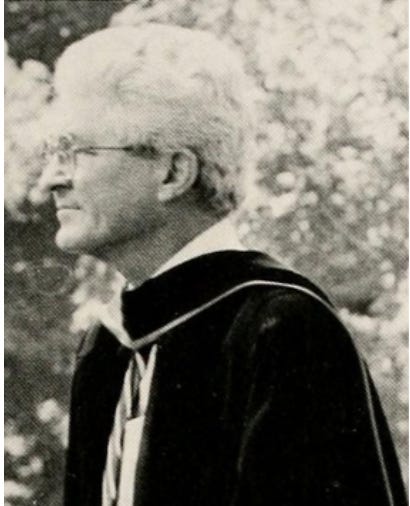
Those sweet fragments of learning: an experience reading Homer with a beloved guide is the kind that I don’t want to dilute with a Hollywood movie. A few years after I graduated, Professor Stirling died of cancer on a Christmas Eve at the age of 54. Stirling also loved movies, and I usually saw him at ‘free movie night’ every Thursday at the Sewanee Union Theater. The coffeehouse on Sewanee’s campus is named after him.
After death, we live on in the fragmented memory of those who knew us.
That’s why stories matter. Stories are experiences allowing us to view the world around ourselves. Often, I feel that I’m wasting my time, not taking the best advantage of my skills, by focusing on AI in the context of storytelling. Shouldn’t I be doing something more substantial than tinkering with AI-generated film clips and imagery? I wonder.
I have been on this journey of understanding how we tell and read stories in digital media for more than 25 years, though as an undergrad I never knew this path would exist. Now, more rapidly than ever, we’re moving towards new genres of stories only capable through an AI-enabled medium.
I can’t remember which translation we read in college; I have long lost my college books and notes. I think it was the Lattimore translation, and not the Fitzgerald translation read by Dan Stevens for the audiobook.
What we suffer through as students. I’ve always enjoyed reading, learning, and writing. But I hated homework, and the pressure of assignments. Throughout college, as an English major, I recall having an essay due seemingly every other week, often weekly. Close reading and intense writing were the hallmarks of a liberal arts education. (Having been on the faculty of a small liberal arts college, I can’t say that is consistently the case any more.) Without the intensity of writing those essays, sometimes staying up all night because I had procrastinated, my methods of thinking would likely be different today. I don’t know the counterfactual since that depends upon so many other choices I could have made as a young man regarding where I attended college and what I chose to study. I often feel now that I made the wrong choice of majors. But I’m also a different person at 60 than I was at 20. I cringe when I think about myself in my twenties.
The resourceful translator
My kid attends a high school with an International Baccalaureate curriculum. The 10th graders are reading Emily Wilson’s translation of The Odyssey. It’s a fine translation for a student, though not what I would choose. I don’t want to wade into the battle of the translations. I suspect that Wilson knows that she is not making the definitive translation but writing for a specific audience of readers.
I am puzzled at some of Wilson’s choice of words, and that she inserts words that leads the reader by the hand in interpretation as if the reader is not smart enough to read the text closely. An example is the opening of Book Nine, where she has the narrator remark, “Wily Odysseus, the lord of lies, answered”. The Fitzgerald translation starts Book Nine with “Now this was the reply Odysseus made”. If you pay attention in reading the Odyssey, then it’s clear that Odysseus is deceptive and not a reliable narrator. Fagles version of that line is “Odysseus, the great teller of tales, launched out on his story”. The Greek is “τὸν δ᾽ ἀπαμειβόμενος προσέφη πολύμητις Ὀδυσσεύς”.
The epithet πολύμητις is the problematic word. Literally, it’s “of many counsels”. From that, a translator has many options. Wilson’s use of “Wily” is not incorrect but it does convey a perspective, especially when paired with “the lord of lies”, which made me laugh when I read it. Other words used could be “resourceful” or “cunning”, which I think would be appropriate. Fitzgerald just skips the adjective entirely.
Wilson strives to make it clear that Odysseus is not a good man, not a hero. But that’s also clearly conveyed through Fitzgerald’s translation, just not with flashing neon signs. Odysseus spends a lot of time with goddesses in the years when he doesn’t seem to be in that much of a hurry to get back to his wife. Odysseus is a deeply flawed person, which is what makes him a great character in an epic story.
As my kid stood, sleepy-eyed, by my desk this morning, I told her that I also was writing an essay on The Odyssey today. The fifteen year-old replied, “Is that supposed to make me feel better?” Indeed, the high school’s assignment is as rigorous as any I had in college except that we were never given a rubric that detailed the structure of our writing. Instead, we usually received a two-sentence prompt on a theme with the expectation that was all we needed to write a thousand-word essay.
An essay: the challenge of composition, fragments, piecing together our thoughts and observations bolstered by quotes from a text. It was that analytical process of writing an essay based only on a close reading of the text, resisting the easier route of using secondary sources, that refined how I approached problem solving. This same process became very helpful as I taught myself to code and understand Internet technologies and how to construct digital libraries.
Finding home
The family reunion of my first cousins on my father’s side of the family happens every year though I’ve not been in 20 years. It’s unlikely I would have made it this year if my brother hadn’t called me a few weeks earlier and asked me to drive down and that we go together.
A 4-hour drive down I-81 into Tennessee. Then, a state highway for an hour. Then, five miles down a narrow, curvy road towards the Powell River leads to a dirt road that takes me to my brother’s trailer where I spent the night. Tennessee is covered by the tributaries that snake off the main rivers traversing through the hills of the state.
The next morning I opted to drive five hours on the scenic backroad, highway 52, to middle Tennessee. I learned to drive on the hairpin curves of highway 52, so I was comfortable maneuvering up, down, and around the hollows. Hardly any traffic on a Thursday morning as we drove along miles and miles of roadway where no one lived until reaching the occasional small towns, like the one where we lived our childhood.
Our maternal grandmother’s house, which was built in the 1920s and our adjoining house where we lived off and on, was razed years ago. The highway was relocated and, the yard where we played for many years now sits under the pavement of highway 52.
After passing through our hometown, we continued down highway 52 towards the farm where my father grew up. “I hate crossing this bridge,” my brother said. In 1977, our father died as his car crashed off that small bridge and down the riverbank.
And then he wept,
despairing, for his own land, trudging down
beside the endless wash of the wide, wide sea,
weary and desolate as the sea.
-Book 13, The Odyssey
My cousins still farm the land that has been in the family since 1825. Don’t mistake that as ever having been a plantation. There’s no grandeur in my family’s history. For the reunion, we gathered in the community room of the small Baptist church down the road from the farm. Somehow, I was asked to give the blessing. Awkward. But I stumbled through the invocation. A framed black-and-white portrait of my paternal grandmother (1904 - 1979) looked down upon me.
I bit my lip,
rising perplexed, with longing to embrace her,
and tried three times, putting my arms around her,
but she went sifting through my hands, impalpable
as shadows are, and wavering like a dream.
Now this embittered all the pain I bore,
and I cried in the darkness.
-Book 11, The Odyssey
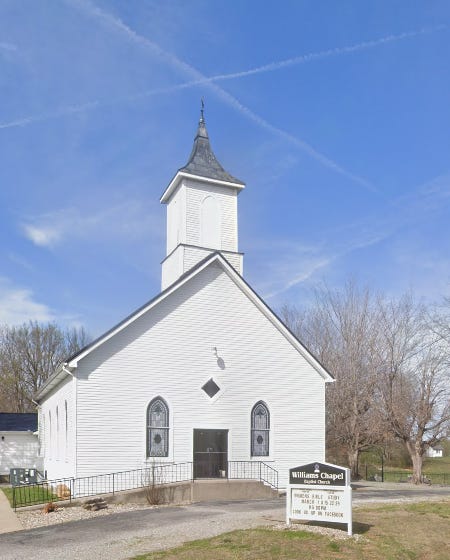
About the reunion, I’m very glad I went. Seeing cousins that I’ve not seen in a very long time sparked a bond, a remembrance of family gatherings in the 1970s. Strengthening those connections is a next step for myself.
Yesterday, I re-listened to Dan Stevens riveting narration of The Odyssey while reading the Fitzgerald translation. Listening while simultaneously reading a text is a superb way of absorbing the work. Is this a life well-spent? Shouldn’t I be posting wittily on X or cranking out video tutorials on the latest AI tools.
My brother and I left the small chapel and took a different route to his home. This time, the backroads of Kentucky led us eastward and then down into the Elk Valley of east Tennessee before reaching my brother’s trailer in the darkness around 10pm that night. The last few miles were my brother navigating, “Curve to your right….curve to your left…now, curve to your right…keep curving…keep curving…now curve to your left.” The automatic high beams on my Subaru kept dimming at the wrong moments on those curves. No ongoing traffic but I could barely see where the road curved.
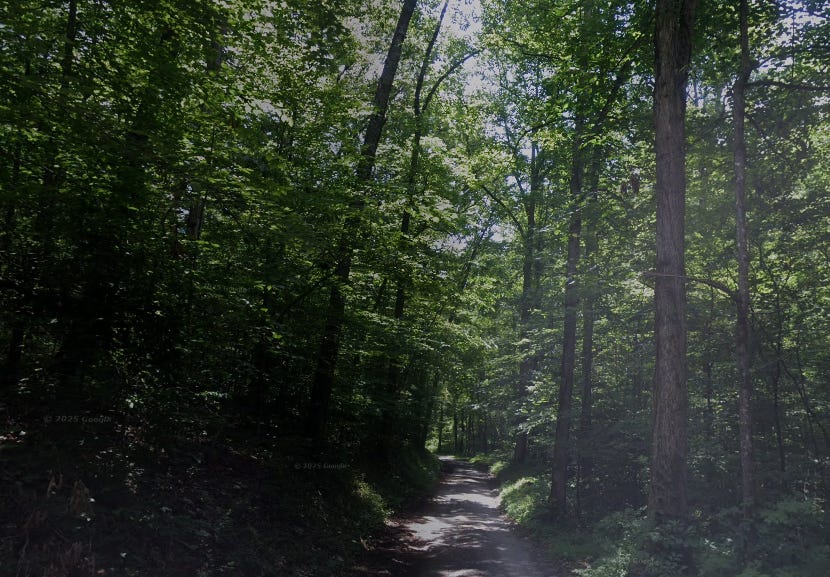
Throughout life, we never know when the road will curve.
Lighting our passage through this world.
In the last few years, I’ve realized a theme of my life’s creative work: absent fathers, identity, memory, and home not as a place but as a state of mind.
I cannot clearly count the number of places I resided, but it’s at least thirty. That’s why, long ago, I have come to think of home as the place wherever I am.
Six hours at my desk. That’s how long I worked on this essay yesterday. A day wasted? Maybe. But it’s a day I’m more likely to remember, a day sitting in thought. Mostly, we are moving through thought, rushing through thought to finish, to produce, to publish content than caring about the process.
I want to believe that AI can help with learning if used properly. But, I’m not sure how, as a student, I would use AI for The Odyssey and not succumb to the temptation, the seduction, of Claude for easing my pain. Since I always viewed homework as an output for merely a grade, which I didn’t value except to impress others, I never had the motivation or the patience to sit patiently with my thoughts as I did my homework. I also felt overwhelmed and a lack of focus as my attention scattered to my real interests.
But if I didn’t suffer through writing those essays during college, would I be able to do what I do now?
The Greek epics, blockbusters of their time, were spun by storytellers with a setting in a time long before the culture of Ancient Greek, and told with larger than life characters for entertainment and as an offering, not to the gods, but as an offering to society as a way of understanding their lives and the world in which they lived.
The audiences for Christopher Nolan’s movie and for Emily Wilson’s translation are very different than the audience listening to bards in ancient Greece. And that’s okay.
you were
more marvelous in your simple wish to find a way
than the gilded roofs of any destination you could reach.
- David Whyte, Santiago